Choose your experience
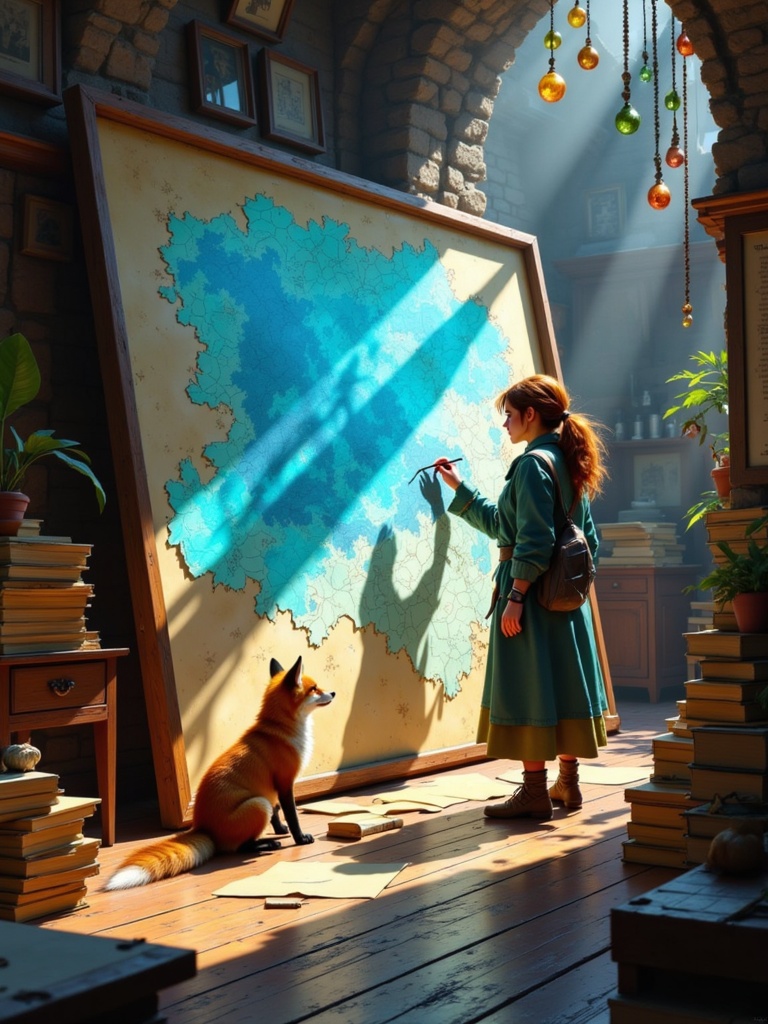
PART ONE The Inheritance - Chapter One: The Brass Tube
The map arrived on the morning of Mara Voss's sixteenth birthday, rolled inside a brass tube with no return address and a postmark that didn't correspond to any postal district she could find. She almost threw it away. Birthday post was usually just cards from relatives she'd met once and was expected to remember — her mother's side, mostly, the ones who'd stopped speaking to them after the funeral and then started again in a careful, measured way, like people testing the temperature of water before they stepped in. Mara had developed a talent for recognising their handwriting on envelopes and leaving them unopened on the hall table for her father to deal with. But the tube was different. Too heavy. Sealed with wax the colour of old blood. And the weight of it, when she picked it up — not heavy exactly, but weighted in the specific way of something that has been waiting to arrive. She took it to the kitchen. Her father was already at work; he left before seven most days, leaving a note and something vaguely nutritious in the fridge that she was expected to eat for breakfast. The house was quiet in the good way — the way it was before the day started asking things of her. She worked the wax seal off with a butter knife and slid out the contents. It wasn't paper. The single sheet that unrolled onto the kitchen table was something she had no name for — thin as paper but rigid in a way paper wasn't, cold to the touch even in a warm kitchen, and faintly luminescent, as if it had been somewhere dark for a long time and still carried a memory of light. It resembled, she thought, the inside of an oyster shell, or the surface of certain old mirrors before they go grey. On it, drawn in lines so fine they seemed to breathe, was a map. Not a map of anywhere she recognised. The streets curved in spirals that didn't correspond to any urban planning logic she was aware of. The topography was suggested rather than stated — hills implied by the way buildings clustered, a river or canal visible in the gaps between districts. Text was scattered throughout in a script she couldn't immediately identify, though something about it nagged at her in a familiar way, as if it were a word she knew in a language she'd forgotten she'd studied. At the centre of the map was a single mark: a small compass rose, drawn with extraordinary delicacy, each direction indicated in both the unknown script and a symbol that might have been a letter or might have been a number. Beside it, in handwriting that was unmistakably her grandmother's — small, leftward-leaning, the product of a left-handed person who'd been made to write right-handed as a child — three words: Find what's missing. Mara sat down. She looked at the map for a long time. Her grandmother had been dead for eight months.
The tube had come from somewhere in the Midlands, according to the postmark, which was a city Mara had been to twice: once for a school trip to a museum, and once for a cousin's wedding that she remembered mostly as a series of rooms in which she didn't know where to stand. She photographed the map on her phone before she did anything else, because she was sixteen and thorough and because her first instinct, when confronted with something she didn't understand, was to preserve it. Then she went to school. School was, as it often was, a series of rooms in which she was present without being entirely there. She had the ability, honed over three years of being the-girl-whose-mother-died, to occupy a space while her mind was somewhere else entirely. Teachers sometimes noticed and sometimes didn't. Most of them had learned to leave her alone when she was clearly thinking, which she appreciated. In history — last period, the class where Mr Pennick let them work independently — she got her phone out under the desk and looked at the photograph of the map again. The script. She'd been turning it over all day, and now she had it: it was related to something she'd seen in a book about early cartographic notation, a system developed by a guild of mapmakers in the sixteenth century who'd wanted a way to annotate their maps that couldn't be read by rivals. Not identical to that notation — evolved from it, or descended from it, or perhaps simply related to it in the way that languages are related, sharing roots without sharing meaning exactly. She looked at the text nearest the compass rose. Three phrases. She worked at them slowly, the way you work at a lock you're not sure you have the right key for. The first, she thought, meant something like: the city that was taken from its place. The second was harder. Something about a boundary — a threshold, or an edge, or the place where one thing becomes another. The third was clear enough to make her stomach drop slightly: this is the way in. She put her phone away and stared at the back of Jamie Hendricks's head for the rest of the lesson and thought about what it meant that her dead grandmother had sent her a map to a city that apparently wasn't in its place anymore, and whether she was going to do anything about it, and what kind of person she was depending on the answer.
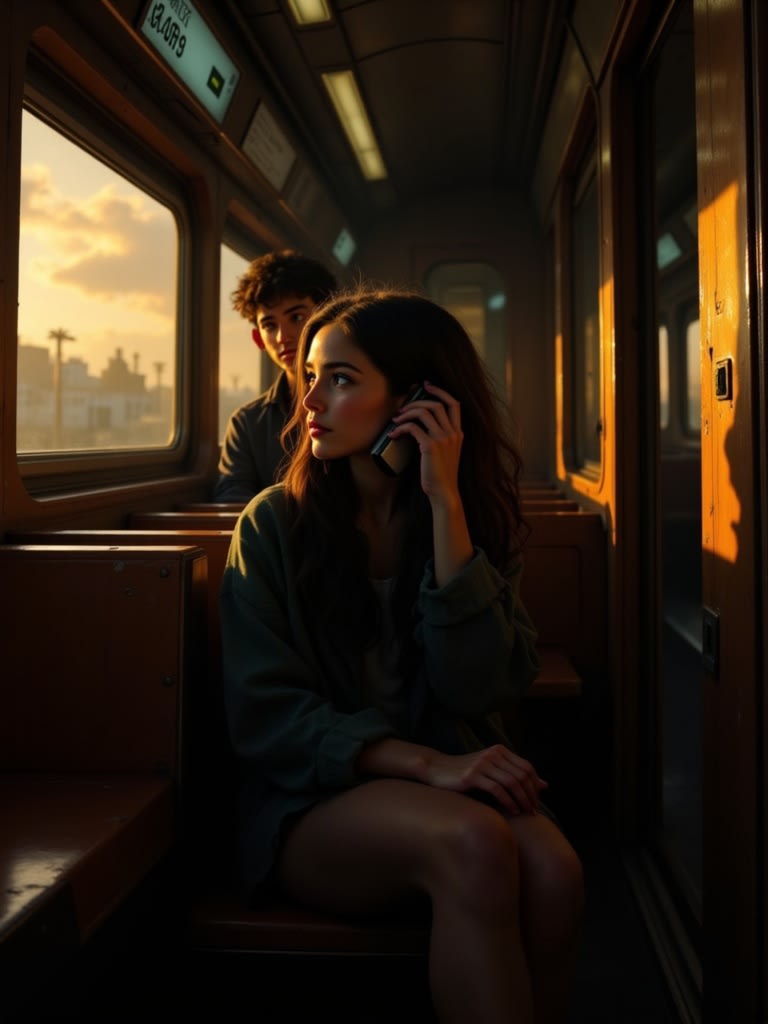
She called her father that evening while he was still on the train home. 'Did Grandma have — I don't know how to put this — did she have anything to do with cartography? Maps?' A pause on the line. The sound of the train. 'She worked in a library for most of her adult life,' he said. 'She had — she knew about maps. She cared about them. Why?' 'What kind of maps?' Another pause, longer. 'Old ones,' he said, and his voice had the quality it sometimes got when he was deciding how much to say. 'She was interested in maps of places that had changed. Or disappeared. She wrote some papers about it, years ago. Before I was born. I never quite understood what they were about.' 'Do you have them? The papers?' 'Some of them. In the study, in the green folders. Mara—' 'I got something in the post today,' she said. 'I'll show you when you're home.' She hung up and went to the study.
Chapter Two: The Green Folders
The study had been her father's for her whole memory, but before that it had been her mother's — she knew this from photographs, and from the way her father sometimes paused in the doorway as if adjusting to a room that hadn't quite finished changing yet. It was full of books in no particular order, a desk that served more as a horizontal filing system than a working surface, and three tall shelves in the alcove to the left of the window. The green folders were on the bottom shelf. Four of them, fat with documents, the kind of folders that predated digital storage and suggested a researcher who worked with paper by preference. She took them to the kitchen table — more space, better light — and opened the first one. Her grandmother's name was Dr Ruth Voss, and she had been, it turned out, something considerably more specific than someone who worked in a library. The papers in the first folder were academic — published in journals Mara couldn't find online, which suggested they were old enough to predate comprehensive digital archives. The writing was dense and careful, the voice of someone who had spent decades learning to say precise things precisely. The subject, as far as she could tell from an initial skim, was the relationship between maps and the places they described. Not in the way that would be immediately obvious — not accuracy, not projection, not the politics of what gets included and what gets left out. Something stranger: the question of whether maps that are sufficiently detailed, sufficiently authoritative, could begin to define the places they depicted rather than simply describe them. She read that twice. The question, as her grandmother explored it, had a historical precedent — she cited several examples of towns that had changed physically to match an official survey, the survey effectively overwriting what had been there before. Normal enough, perhaps: official maps get used for planning decisions, for infrastructure, for official record. Of course places change to match their maps when the maps are used to govern them. But her grandmother was interested in something subtler and, Mara thought, considerably stranger: the possibility that certain kinds of maps — made by certain kinds of people, in certain ways — could achieve this relationship not through official processes but directly. That the map and the mapped could become so entangled that which came first ceased to be a meaningful question. And what happened, the papers asked, to a place that was mapped out of its own reality? Not destroyed. Not erased. But displaced. Moved, somehow, into a different relationship with the world that the rest of us inhabited? Mara closed the folder and sat with her hands flat on the table. The map in the brass tube was upstairs in her room. Find what's missing. She opened the second folder.
Her father came home at seven. She'd made pasta because it was her turn and she'd needed something to do with her hands. They ate at the kitchen table with the green folders pushed to one end and the brass tube between them. He picked it up and turned it over in his hands. Read the non-existent return address. Looked at her. 'She sent this before she died,' Mara said. 'Had to have. She set up a delayed delivery somehow, or left it somewhere with instructions. She planned this.' 'She planned a lot of things,' her father said, with a specific tone that suggested this was a quality he'd inherited mixed feelings about. 'Did you know what she was researching? What she actually believed?' He set the tube down. He was quiet for a moment — the same quality of pause as on the phone. 'She believed,' he said carefully, 'that certain places had been displaced. That they existed, but in a different relationship to ordinary geography than places like this.' He gestured vaguely at the kitchen, the house, the road outside. 'She said she'd been to one of them, once. When she was young. She described it differently at different times — sometimes like describing a dream, sometimes like describing somewhere she'd actually been, been able to touch the walls of.' 'Verendal,' Mara said. He looked at her sharply. 'Where did you — the folders?' 'Second one. And the map.' She spread the photograph of it on the table between them. 'Look at the script here. And here. I think this says: the city that was taken from its place.' He looked at the photograph for a long time. 'She wanted you to find it,' he said. 'I know.' 'Are you going to?' Mara thought about what kind of person she was depending on the answer. 'Yes,' she said.
Chapter Three: The Footnote
Finding Verendal in any official record took three weeks and required the kind of methodical patience that Mara had in abundance when she considered something worth the effort. She started digitally: every combination of search terms she could think of that might connect the word Verendal to any catalogued source. The searches returned nothing useful — some false matches, a few forum posts by people interested in lost places and unusual geography, nothing that looked like documented fact. She went to the school library and asked Mr Rao, the librarian, for access to the academic database. He gave it to her without asking questions, which was one of the things she appreciated about Mr Rao: he understood that her reasons were her own business. Three days of academic searching. She found references to the concept her grandmother had explored — the relationship between maps and the displacement of places — in several papers written by people she'd never heard of, in journals she'd never heard of, published in years ranging from 1924 to the mid-1980s. The references connected in a network: paper A cited paper B, which cited papers C and D, which both cited E, which cited something called the Ashwick Correspondence. She couldn't find the Ashwick Correspondence anywhere accessible. She went to the public library on a Saturday morning and asked the reference librarian — an older woman with the deliberate calm of someone who had heard many unusual research requests and processed all of them with equal efficiency — for help finding it. 'Ashwick,' the librarian repeated, typing. 'Correspondence. What field?' 'Cartography. Or something related to it. The citations I have are from the 1920s and 30s.' Typing. A long pause. 'There's a reference here to a collection held at the University of the North. Personal papers of a Roland Ashwick, cartographer, donated to the university archive in 1962 after his death.' She looked up. 'Not digitised. You'd need to contact the archive directly to access the physical collection.' 'What else?' More typing. 'There's a secondary citation — footnote in an atlas, not a journal. Published 1934.' She read from the screen the entry for Verendal, listed as a cartographic anomaly, unverified, with a reference to Ashwick 1931. Mara wrote it down in her notebook. Cartographic anomaly, unverified. The language of a reference that wasn't sure what to do with what it had found. 'Can you find where the atlas is held?' 'It's out of print. One copy in the university archive. Two in national collections, both restricted. And one—' The librarian's eyebrows rose slightly. 'One in a secondary school library in the north of the city.' Mara's school was in the north of the city.
The atlas was in the back room of the school library, in a section of reference materials that Mr Rao described as 'the overflow — things that came with the building and haven't been catalogued yet.' It was a large, heavy volume with a dark green cover and gold lettering that had mostly worn off, and it smelled of the specific past: not unpleasantly, but with the authority of something that had existed undisturbed for a long time. She found the footnote on page 847. Exactly as the reference librarian had read it. She looked at it for a moment, then turned the page. There was handwriting in the margin. Very small, very precise, in ink that had faded to brown. She read it under the library's overhead light, tilting the book toward it. It said: The anomaly is real. I have been there. Three times. The displacement appears to be a function of the original mapping, which was deliberate, not accidental — someone mapped it out of ordinary geography with intention. The route changes. The city does not. Unsigned. But the handwriting was, she was almost certain, the same as the handwriting she'd found in the second green folder — her grandmother's, in its younger form, before age had made it smaller and more careful. She photographed the annotation with her phone. Someone sat down across from her. She looked up. It was a boy she vaguely recognised from the year above — tall, sandy-haired, carrying the kind of battered leather satchel that looked like it had a previous life as luggage for someone's grandfather. He was looking at the atlas in her hands with an expression she couldn't read. 'Ashwick,' he said. 'Sorry?' 'The atlas. You found the footnote.' She put the book down on the table between them. 'How do you know about the footnote?' 'Because,' he said, 'Roland Ashwick was my great-grandfather, and I've been waiting for someone to find that footnote for about three months.' He stuck out his hand across the table. 'Theo,' he said. 'I wondered when you'd come.'
Chapter Four: What Theo Knew
They talked for two hours in the library, and then for another hour in the café around the corner, and then Mara walked home alone in the cold and sat in the kitchen and processed what she'd learned. Theo Ashwick had grown up knowing what his great-grandfather had done for a living — the official version. Roland Ashwick had been a cartographer, well-regarded in his time, whose work had appeared in several respected atlases of the early twentieth century. Accurate, elegant maps of real places. The kind of professional legacy you could be quietly proud of. The other version, Theo had found in a locked box in his grandmother's attic two years ago. Notes, correspondence, a journal covering a period from 1918 to 1947. The journal was, he said, extraordinary and deeply strange, and he'd been trying to find someone else who would understand it ever since. 'My grandmother wouldn't talk about it,' he said, wrapping both hands around his coffee. 'She said it was your grandfather's business and he'd taken it with him when he died. But she kept everything. She kept all of it locked in a box in the attic and I think — I think she wanted someone to find it, she just couldn't be the one to open it.' 'What does the journal say?' He'd brought it. Of course he had — she was getting the impression that Theo Ashwick had been waiting for this conversation for quite a while and had prepared for it with some thoroughness. The journal was leather-bound, the size of a paperback, its pages dense with his great-grandfather's handwriting. Roland Ashwick had, in the journal, documented his involvement with a group of cartographers who worked outside ordinary professional practice. Not fraudulent — they made accurate maps of real places alongside their other work. But the other work was different in kind. They mapped places that existed in the marginal space between official geography and something else, something that Roland described at different times as: the geography of attention, the landscape of collective memory, the territory of what has been true. And they made another kind of map altogether. A kind that didn't describe places but defined them — that could, in the right hands, using the right materials, with sufficient precision and intention, relocate a place. Move it sideways, Roland wrote, into a different relationship with the world most people inhabited. 'He did it,' Theo said. 'He moved places. Or helped to move them. He doesn't say it directly but it's there in the journal — references to places he'd been that other people couldn't find afterward, cities he'd mapped that others dismissed as fiction.' 'Verendal.' 'Verendal.' He nodded. 'He wrote about it more than any of the others. He had a — I think he had a complicated relationship with it. It was the last one. After Verendal he stopped doing the mapping work. Just made ordinary maps for the rest of his career.' 'Why?' Theo was quiet for a moment. 'He writes at the end of the journal that he'd made a mistake. That one of the displacements had been done wrongly — with intention, but the wrong intention. He doesn't say whose intention. He doesn't say which city.' 'But you think it was Verendal.' 'I think it was Verendal,' he said. 'And I think your grandmother knew that too.' Mara looked at her coffee. At the photograph of the map on her phone. At the three words in her grandmother's handwriting. Find what's missing. 'She didn't want me to find it,' she said, slowly. 'She wanted me to put it back.'
She told him about the green folders. About her grandmother's papers. About the theory of displacement and the relationship between maps and the places they described. He listened carefully, the way she was coming to understand he listened to most things: with his full attention, without interrupting, making small notes in a spiral-bound pad he produced from the satchel. 'She'd been there,' he said. 'You said she'd annotated the atlas herself — she said she'd been there three times. So she knew it existed, she knew it was displaced, and she spent her career studying the mechanism by which it happened.' 'And she sent me a map and three words instead of telling me any of this directly,' Mara said. 'Why would she do that?' Mara thought about it. About her grandmother's methodical precision, her long silences, the careful way she'd always said exactly what she meant and nothing more. About the kind of person who would spend decades studying something and leave the conclusion to someone else. 'Because the conclusion only means something if you reach it yourself,' she said. 'Because she couldn't take me there — she was too ill by the end, and anyway, she'd already spent thirty years trying to understand the problem. She needed someone who could solve it.' She paused. 'She needed someone who could make a true map. And she thought I could.' Theo looked at her. 'Can you?' he said. 'I've never tried,' Mara said. 'I suppose we'd better find out.'
PART TWO The Route Changes - Chapter Five: The Materials
Finding the right materials to make a map that was more than a map turned out to require a shopping list that would have looked, to any reasonable observer, simply like the supplies of a person who enjoyed old-fashioned cartography as a hobby. This was partly intentional. Mara had found, in her grandmother's papers, a list of materials titled 'Requirements for True Work' — the handwriting from earlier in her grandmother's life, bolder and more hurried than the version she'd known. The list was technical in parts she didn't understand and refreshingly practical in others: high-quality rag paper, iron gall ink, a set of precision drawing instruments, and — underlined twice — a compass that had been made, not bought. 'Made by whom?' Theo had asked when she'd read the list to him. 'By the cartographer. Herself.' Mara had re-read the line three times to make sure she was reading it correctly. 'It says: the compass must be the cartographer's own work. Not because of any mystical reason. Because the act of making it teaches the maker to understand direction in a way that cannot be learned otherwise.' She had, as a child, been taken by her grandmother to a workshop — she remembered it vaguely, an afternoon of heat and precise small tools and the smell of metal — where her grandmother had made something small and bright. She'd been young enough that the memory was more sensory than factual. She called her father from school on a Wednesday afternoon. 'The workshop,' she said. 'When I was small. Where Grandma took me.' A pause. Then: 'The instrument maker's. Yes. She went every year.' 'Do you have the address?'
The instrument maker's workshop was in a lane off the market quarter, in a part of the city that had survived several decades of redevelopment by being too narrow and inconvenient to attract serious commercial interest. The sign above the door was hand-painted and slightly faded: PRECISION INSTRUMENTS. MADE TO ORDER. EST. 1947. Inside, it smelled of metal and oil and something else — a warm, mineral smell that Mara recognised from her fragmentary memory of the place. The same smell. Eight or nine years later and the same smell, which meant either that the smell was structural — baked into the walls — or that the work being done inside was continuous. A man emerged from the back. Older, white-haired, with the careful hands of someone who spent his life working at small scales. 'Can I help?' 'I'm Ruth Voss's granddaughter,' Mara said. 'I need to learn to make a compass.' He looked at her for a long moment, in the way that people sometimes looked at her when they were seeing something other than her — some resemblance, or some context. 'She said you'd come,' he said. 'When you were ready. Come through to the back.'

His name was Mr Farr. He'd known her grandmother for forty years. He didn't explain their relationship in any more detail than that, and Mara had learned enough by now to understand that some things were given in their own time. He taught her over four Saturdays. The making of a compass — a real one, functional, calibrated — was a precise and demanding process. She made mistakes on the first and second day that required starting over. On the third day she had it right but not well, and he made her do it again. 'The making is the learning,' he told her. 'Not the finished object. The finished object is just the proof.' She thought about what her grandmother had written: because the act of making it teaches the maker to understand direction in a way that cannot be learned otherwise. She didn't understand direction in that other way after the first Saturday. Or the second. On the fourth Saturday, working at a bench under a lamp in the quiet of the workshop while Mr Farr made tea in the kitchen, she calibrated the finished compass against a reference instrument and felt something shift in her understanding — not of the compass, but of something the compass was pointing at. Something that wasn't on any ordinary map. She held the compass flat on her palm. It pointed not quite north. It pointed inward.
Chapter Six: Learning to See
Mara had always drawn. It was the kind of thing she'd never made much of — not art exactly, more like notation, the way some people take notes in words and she took them in images. Observations. Spatial relationships. The way a room was arranged, the way a street corner worked, what a face looked like from a particular angle. She hadn't considered it a talent so much as a habit. Looking at her grandmother's notes on what made a true map, she began to understand that this was exactly the right preparation and also exactly insufficient. 'A true map,' the notes said, 'describes not the appearance of a place but its fact. This requires the cartographer to see what is there rather than what they expect to find. This is considerably harder than it sounds.' She started practicing. Not with the special materials — she was rationing those, not yet sure she was ready to use them — but with ordinary pen and paper, drawing places she knew well and then comparing her drawings to the places themselves. The discrepancies were instructive. She drew the kitchen from memory and found she'd made the window larger than it was, the table shorter, the space between the counter and the door wider. Not because she'd been careless but because that was how the kitchen felt — the window always seemed large, the table always seemed too small for the pile of things on it, the path to the door always felt constricted. Her map showed the kitchen as it felt, not as it was. She drew it again, this time forcing herself to measure. The second version was more accurate and considerably less interesting. 'The true map,' she read in her grandmother's notes, 'is neither. It shows what is there and what it means. Both. Not feeling instead of fact, but feeling as a kind of fact — one layer of many.' She spent three weeks drawing places she knew, trying to find the version that was both. It was harder than anything she'd tried to do in her life. She threw away more drawings than she kept. Theo, who was beginning to show up at the library on the same afternoons she used it, looked at her discards once and said they were extraordinary. 'They're wrong,' she said. 'They're interesting. What's wrong with them?' 'This one' — she held up a drawing of the school car park, which was where she'd been going to practice because it was reliably unemotional and she thought she'd have an easier time being objective about it — 'shows the car park as it would look if everyone who'd ever been anxious in it had left a mark. All these shadow-lines. It doesn't look like a car park.' 'It looks like a painting,' Theo said. 'It looks like my feelings about a car park. That's not the same thing.' She took the drawing back. She looked at it for a moment. 'But the lines are where they are for a reason,' she said slowly. 'The anxiety is real. The anxiety happens in the car park. Maybe the map isn't wrong — maybe I just don't know yet how to show both the space and what happens in the space on the same piece of paper.' Theo was quiet for a moment. 'Your grandmother could do it,' he said. 'How do you know?' He reached into the satchel and produced a folded piece of paper — carefully, as if it was old. 'Because I found this in the journal. She left it there, tucked between pages. I think it's a map of somewhere real. I think it might be one of the early ones. And it's—' He unfolded it and put it on the table. She looked at it for a long time. It showed a street corner. Ordinary-looking street corner, old-fashioned, the drawing style of someone trained in an earlier tradition. But there was something about it — the shadows in the right places, the proportions somehow exactly true, and underneath all of that a quality she could feel but not name: the sense of a place as it actually was, not as it appeared. 'She could do it,' Mara said. 'You will too,' Theo said. He said it in the way of someone stating a fact they were confident in, which she appreciated more than she could easily say.
She was nearly there — she felt it, the way you feel the edge of understanding before you actually have it — when school ended for the summer and her father said something about visiting her aunt in the south of the country for a week, which was the last thing she wanted to do and also non-negotiable. She brought the drawing materials, the green folders, her notebook, and the compass. The compass, she'd noticed, had stopped pointing inward. Or rather: it pointed inward most of the time, but there were moments — usually in the morning, around dawn — when it swung to a different direction entirely. Not north. Not any direction she'd have been able to name before she'd spent four Saturdays in Mr Farr's workshop. She stood at her aunt's window on the second morning, compass on her palm, and watched it swing toward a direction she had begun to understand. She took out her drawing materials and began to draw the view from the window. Not the view as she saw it. The view as it was. When she was done — two hours later, the family long since at breakfast and mildly annoyed about it — she looked at what she'd made. It was right. Both layers. The space and what it meant, held on the same piece of paper without either cancelling the other out. She sat on the bed and thought about her grandmother leaving her a map in a brass tube and three words as instruction. She thought about a city displaced into a different relationship with ordinary geography. She thought about what it meant to map something truly, and what it would mean to map Verendal — displaced, lost, taken from its place by a map made with the wrong intention — back into where it belonged. She called Theo. 'I've got it,' she said. 'I know how to make the map. We need to find Verendal first. I need to see it.'
Chapter Seven: Three Trains and a Door
Finding Verendal required, according to the notes her grandmother had left embedded in the green folders and — more usefully — the specific directions Theo had found in his great-grandfather's journal, a sequence of observations. Not observations of Verendal. Observations of the world as it was without Verendal in it — the particular quality of absence that a displaced city left, like a tooth pulled from a jaw. Roland Ashwick had mapped this absence across three decades: the places where the geography felt wrong, where the air had a quality of adjacency, where if you stood very still and looked at nothing in particular you could feel the edge of something that wasn't where it should be. The observations converged on a corridor: a stretch of country in the north of England, upland, mostly agricultural, bisected by a B-road and a train line that served three small stations. The kind of landscape that looked, from a moving window, like England's placeholder — the default between significant places. They took three trains on a Saturday in August, arriving at the smallest of the three stations at half past two in the afternoon. The station had a single platform and a car park and a bus shelter with a timetable that suggested buses were theoretical rather than actual. 'This is it?' Theo said, looking at the landscape. 'This is where the absence is,' Mara said. She had the compass in her hand. It was pointing with a steadiness it hadn't shown before — not inward this time but outward, toward something specific, in the direction of a stand of trees about half a mile to the east. They walked. The country was pleasant and unexceptional. Dry-stone walls. Sheep in the middle distance. A farmhouse on a ridge, a tractor moving slowly along a far field. Everything was exactly what it looked like and nothing about it suggested hidden cities or displaced geography or the work of cartographers who'd operated outside the boundaries of ordinary mapmaking. And then the trees. Not the trees themselves — the trees were ordinary birches, nothing spectacular. But in the space between them, there was a door. Not a magical door. Not a door in the air. A door in a wall that was partly ruined, clearly old, the stone darkened with age and the mortar mostly gone. The wall was a remnant of something — a building demolished long ago, its other walls absent, the ground around it grown over. But one section remained, and in it, a door. Oak, iron-hinged, the paint long gone. A door that had no obvious function in a wall that didn't enclose anything. It was, however, shut. Mara walked up to it. The compass was steady in her hand, pointing directly at it. 'Right,' she said. 'Right,' agreed Theo. She put her hand on the iron handle. The metal was warm — warmer than it should have been in August afternoon air. She pushed. The door opened.
The smell came first. Woodsmoke and something sweeter — burnt sugar, or caramel, or the particular warmth of bread baking in a stone oven. Then the sounds: voices, not close, and water, and the particular murmur of a place that contains people going about their ordinary business. Then the light, which was wrong in the way she'd been trying to understand since she'd read her grandmother's description of it: not wrong like darkness or like too much brightness, but wrong like a photograph taken with the white balance slightly off. The same light, differently calibrated. She stepped through. The door was set into a wall here too — a section of old wall at the end of an alley, which opened onto a street. The street was narrow. Buildings pressed together on both sides, tall and narrow themselves, upper floors almost meeting overhead. The lanterns hung at odd angles, which she hadn't expected to be literally true but was. Stone beneath her feet, worn smooth by many years of use. She stepped fully into the street and looked back. Theo was still on the other side. 'Come through,' she said. He stepped through. He looked at the street. He looked at the sky, which was the not-quite-right colour. He looked at the lanterns. 'This is Verendal,' she said. 'Yes,' he said. His voice was strange — not afraid, but moved, in the way of someone who has spent two years reading about a place and has just found themselves inside it. At the end of the alley, a woman was walking slowly toward them with the unhurried gait of someone who had known they were coming.
Chapter Eight: The Archivist
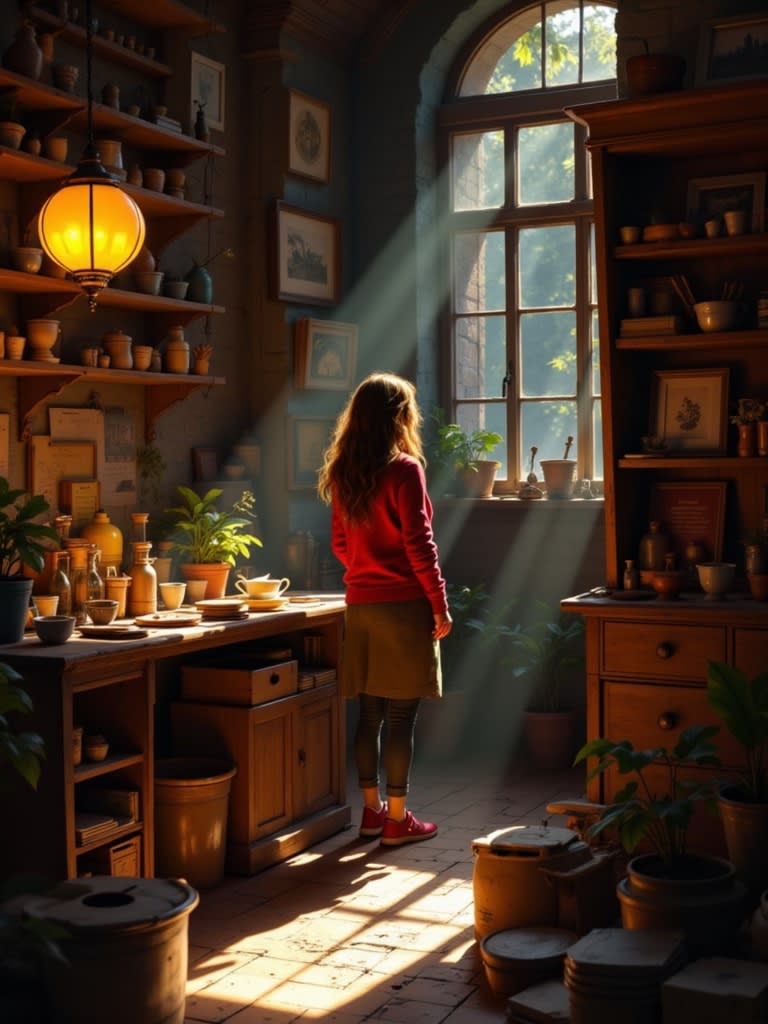
Her name was Sable. She ran a shop that sold memory — that was how she described it, and it took Mara a moment to understand that she meant this literally in some respects and metaphorically in others: the shop contained objects that carried their histories with them, documents and instruments and small ordinary things that had belonged to people and in belonging had become, in some sense, part of what those people had known and felt. She also, it turned out, served tea. Good tea, in mismatched cups, at a table in the back of the shop that was clearly the actual purpose of the space in front. 'I've been expecting someone,' she said, setting cups down. 'I didn't know when.' 'How long have you known it needed to be done?' Theo asked. She considered. 'How long has Verendal been displaced?' 'We don't know exactly. Roland — my great-grandfather—' 'I know who Roland Ashwick was,' she said, not unkindly. 'He visited here three times, as your grandmother did' — this to Mara — 'and each time he came closer to explaining what had happened. But he never had the skill to correct it. He was a fine cartographer of the ordinary kind. What was done here required something more than ordinary.' 'What was done?' Mara asked. Sable wrapped both hands around her cup. 'A map was made of Verendal in the years after the First World War. Made by a cartographer of some ability — not the kind Roland worked with, but someone who had found their way to similar methods through different means. The map was made with precision. It was accurate in all its details. But the intention behind it was wrong.' 'What was the intention?' Theo asked. 'To take Verendal out of the world.' She said it plainly, the way you state a fact that is settled. 'Not to destroy it. Simply to remove it from the geography that everyone else inhabited. The cartographer had reasons — private ones, connected to things that happened here before and during the war, things I won't go into in detail. The displacement was a kind of punishment, or a kind of preservation, or both. The cartographer never quite decided which.' 'And the people here,' Mara said. 'They know? They know they've been displaced?' 'Most of them know something is wrong. They feel it in the quality of the sky, in the difficulty of communication with the outside, in the way that people they love in other places become gradually less accessible. Some of them have been trying to reverse it for years. But the reversal requires someone from outside — someone with the skill to make a true map, and the particular connection to the original displacement that allows them access to the mechanism.' She looked at Mara. 'Your grandmother understood this. She spent her life preparing someone else for the work she couldn't complete. You are that person.' Mara looked at her tea. It was very good tea. She thought about what it meant to be told, plainly, that your dead grandmother had planned your entire involvement in something for most of your life without telling you. She decided she'd figure out how she felt about that later. 'Tell me what I need to do,' she said.
PART THREE The True Map - Chapter Nine: Walking the City
They stayed for six days. Mara's father had been told — carefully, with the kind of precision she'd learned from her grandmother's notes — that she was visiting Theo's family in the north for a week as part of a research project for school. This was technically true in all the ways that mattered and untrue in several ways that she'd have to account for eventually. Verendal, for all that it existed in a displaced relationship with ordinary geography, was not an otherworldly place. People lived their lives in it. They had shops and schools and the small complications of daily existence. They ate breakfast and argued about directions and had opinions about the weather, which was, Mara noticed, generally better than the weather outside the city — as if the displacement had also displaced it slightly from the climate that surrounded it. She walked every day. All day, from early morning, with her notebook and her drawing materials. Theo walked with her — he was good at walking, she'd discovered, in the sense that he could walk in companionable silence without making the silence awkward, and he was useful as a second pair of eyes because he noticed different things than she did. She drew. Not the true map yet — that required the special materials, the compass, the iron gall ink, the rag paper she'd prepared. What she drew in the first days were observation drawings: the same kind of practice she'd been doing for weeks, but now in the place itself, developing her understanding of its actual geometry before she tried to render it truly. Verendal was beautiful. She hadn't expected that, or rather she'd expected a different kind of beauty — something strange and otherworldly, beauty that announced itself. What she found instead was the quiet beauty of a place that had been lived in for a long time by people who cared about it: the way the stone of the buildings had been maintained, the small gardens squeezed into unexpected corners, the quality of the lanternlight at dusk. And underneath the beauty: the wrongness. Not in the place itself, but in the way it sat in its location. She could feel it now she was here, the cartographic equivalent of a note played slightly flat — everything correct individually, but the relationship between the whole place and the geography around it subtly, persistently wrong. 'It's like a building that's settled slightly,' she told Theo on the third evening. 'Nothing's collapsed. It's still standing, still functioning. But you can see the cracks where it's moved from where it was built.' 'And you can fix it?' She'd been thinking about this. 'The original map defined it out of its location. If I make a map that defines it back — that states precisely and truthfully what this place is, where it is, how it relates to the geography around it — then the new map supersedes the old one.' She paused. 'That's the theory.' 'Is it your grandmother's theory?' 'It's what her notes point to. It's what Sable described. It's what Roland's journal suggests.' She looked at the street. 'It's also what makes sense to me. Which I think matters.' Theo nodded slowly. 'When will you start the real drawing?' 'Tomorrow morning,' she said. 'I've seen enough now. I know where everything is.'
She sat that evening with Sable's tea and her notebooks and went through everything she'd observed. The notebook was full — she'd drawn fast and continuously, building a comprehensive picture of the city in all the layers the true map would need to carry: the physical geography, the built environment, the human patterns, the quality of the place as it actually was rather than as it appeared. She looked at what she'd gathered. She could do it. She'd been uncertain until tonight, holding the question open as she'd learned to, not letting herself decide until she had enough information. But tonight she looked at what she knew and felt the certainty settle. She could make the map. What she couldn't be sure of was whether making it would work.
Chapter Ten: The Drawing
She began at dawn on the fourth day and she worked for three days straight. Not without stopping — she slept, briefly, and ate when Theo brought food. But the drawing was continuous in the sense that she never fully left it: when she put down the pen to sleep, the map continued in her mind, and when she picked it up again she was already in the middle of it, the city and its true geometry present to her with a vividness she'd not experienced in any previous work. The rag paper was beautiful to draw on. The iron gall ink moved differently from ordinary ink — more slowly, more deliberately, as if it understood that what was being set down was meant to last. The compass sat at the corner of her working surface, steady, pointing at the city around her with a consistency that was itself a kind of confirmation. She started with the overall structure — the major streets, the districts, the topography. This was the layer of fact, the skeleton of the map, and it had to be precise in the ordinary sense before anything else could be true. She measured distances by walking them. She calibrated her angles against the compass. She was, she would have admitted to no one but herself, doing something that looked entirely like an act of craft and felt, in the doing, like something else.
The second layer: the buildings. Not their facades but their facts. She'd learned to see the difference in her weeks of practice. The facade was what the building showed. The fact was what it was — its age, its use, its relationship to the street and the other buildings and the people who inhabited or passed or used it. She drew a baker's that had been in the same building for four generations, and felt in the drawing the accumulated weight of that continuity — not sentimentally, but factually, the way good brick carries heat. She drew a school, nearly empty for the summer, and found herself including not just the building but the quality of absence that a school has when the children are away. She drew a small square with an off-centre fountain and understood that the off-centre-ness was the point: the square had been designed around a specific view, the fountain placed to mark the sight-line, and the whole arrangement was a kind of argument about where attention should go. The third layer was the hardest and the most important. She'd been trying to articulate it for weeks without finding the right language. It was the layer of what a place meant to itself — not what it meant to outsiders or to official geography, but its own sense of its own nature. The argument a place made, by existing and by being as it was, about what was valuable and what was true. Verendal, displaced from its proper location, still knew what it was. She could feel this in the confidence of its streets, the lack of apology in its architecture, the way people moved through it — with the assurance of people who belonged somewhere, even if where they belonged had been taken out of context. She drew this. She didn't know, drawing it, whether she was succeeding or failing. She drew the city as it understood itself, which was to say: as a real place, in a real location, with a real relationship to the geography around it. The location it should have, the relationship it should have. Not the displaced version. The true one. On the third day, at dusk, she put down the pen and looked at what she'd made. It glowed. Not dramatically — not with a visible light, not in a way that anyone watching would have noticed. But when she looked at it with the particular quality of attention she'd spent months developing, the map had the same luminescence as the original glass-paper map, the same quality of having been somewhere dark for a long time and still carrying a memory of light. Except this one was warmer. More certain. It felt, looking at it, like the difference between a description of a person and the person themselves. 'Is it done?' Theo asked. He was standing in the doorway of the room they'd been using, a room Sable had provided without comment. 'It's done,' Mara said.
Chapter Eleven: What the Map Does
She hadn't known what to expect. She'd read her grandmother's notes and Roland's journal and Sable's patient explanations and none of them had described the actual moment. Perhaps because it was different each time. Perhaps because language was insufficient. She placed the true map over the original glass-paper map — the one from the brass tube, which she'd brought with her. The glass-paper had been the definition: the false one, made with wrong intention, that had displaced Verendal from its location. Her map was the redefinition. She held the compass in her left hand and both maps in her right and she stood in the centre of the city's main square — Sable's suggestion — and she read aloud the names of everything. Every street. Every major building. The districts and the sub-districts and the small passages between them. In the script she'd deciphered from the original map, the script that was a descendant of the sixteenth-century cartographic notation, which she'd spent three months learning to read and, in the last weeks, to speak. Her voice shook on some of them. Theo stood two steps behind her and said nothing, which was exactly right. It took forty minutes.
The resistance she felt was not physical — not a wind, not a pressure. It was a kind of stubbornness: the quality of something that had been wrong for so long that wrongness had become its normal state and correctness felt like an imposition. She'd encountered this quality before, in much smaller ways, in the practice drawings she'd thrown away — the version of something that was convinced of its own accuracy because it had never been challenged. She read every name twice. When she read the last name — the name of the square she was standing in — the glass-paper map dissolved. Not dramatically. Not with a flash or a sound. It became gradually less present, the way ice becomes less present when it melts, until there was nothing in her right hand but her own map on rag paper and the compass, which had stopped pointing inward and was now pointing north. For the first time since she'd made it. She looked up. The sky above Verendal was still slightly the wrong colour. And then, slowly, the wrong colour became the right one. Not all at once. Not dramatically. A gradual correction — the way a photograph's colour balance adjusts when you move it into natural light. The sky settling into the particular shade of late afternoon she recognised from the other side of the door. Around the square, the city was quiet. People had stopped — she saw them at the edges of the square, in the windows above, watching. Not celebrating, not yet. The careful stillness of people who are waiting to understand whether something has actually changed. Then someone started walking. Then someone else. And then there was the particular sound of a city returning to its ordinary business, which was one of the most beautiful things Mara had ever heard. Sable appeared at her elbow. 'That's it?' Mara said. 'That's it,' Sable confirmed. 'Or the beginning of it. The correction takes some time to fully establish. But the mechanism is done.' Mara looked at the compass. North. True, ordinary north. 'My grandmother,' she said. 'Did she know this was what I'd do?' 'She knew the what. She was less certain of the how — that was yours. That's always been yours.' Sable paused. 'She was certain you were capable of it. She told me so, the last time she visited.' 'What did she say?' 'She said: my granddaughter sees truly. She always has. She just doesn't know it yet.' Mara stood in the centre of the square with the true map in her hand and the sky the right colour above her and the city going about its business around her, and she thought about her grandmother leaving her a brass tube and three words because she trusted her to work out the rest. She thought: I'll take that. I'll take all of that.
PART FOUR Afterwards - Chapter Twelve: The Return
They stayed two more days. Mara walked the city again — not drawing this time, just walking, learning it in the way you learn a place when you're not looking for anything. She found things she'd missed in the three days of intense focus. A small library at the end of an alley that contained, among other things, a collection of maps that made her catch her breath — some of them she'd heard of, some she'd never encountered before, all of them remarkable in different ways. The librarian invited her to look through them and she sat for four hours going through a collection that would have occupied a serious academic for months. 'You can come back,' the librarian said when she finally stood up and stretched. 'The door will know you now.' 'Can other people come?' 'People who find the door can come. That's always been true. The difference is that now they'll find their way back out reliably.' The librarian smiled — a small smile, the smile of someone who had been waiting for reliability for a long time. 'It was that, really, that was the problem. People could come in. Leaving was — uncertain.' Mara thought about what it meant to live in a place from which leaving was uncertain. The particular claustrophobia of a beautiful place from which you couldn't reliably go. She thought: no wonder the city feels like itself. You'd have to know yourself very well, trapped in your own geography. * * * She talked to Theo in the evenings, after dinner, in the small square near Sable's shop. 'Your great-grandfather,' she said on the second evening. 'Do you think he understood what the original cartographer did? What the intention was?' 'The journal doesn't say directly. He writes that the displacement was done with intention, and he clearly blames someone — there are references to a colleague, unnamed, who he stops mentioning after 1921. The timing fits with when the map must have been made.' 'But he couldn't undo it.' 'No. He kept trying to understand it well enough to fix it. He never got there.' Theo paused. 'I think he felt responsible because he'd taught the person. Or helped train them, at least. He never said that either, but I felt it in the journal. The way he writes about it. A kind of — culpability he hadn't earned exactly but couldn't put down.' 'That's a very familiar feeling,' Mara said. 'Is it?' She thought about her grandmother's papers. About the career spent researching something she couldn't fix herself. About a brass tube and three words. 'She could have tried,' Mara said. 'The last few years, she was still capable of — she could have come back. She chose to send me instead.' 'She thought you were better suited.' 'I know. That's not the same as not minding.' They sat in the square while the city went about its evening business. Someone was playing music from a window above — something she didn't recognise, an instrument she'd have to ask about. 'She was right, though,' Theo said. Mara looked at the map in her bag. The compass at her hip. 'Yes,' she said. 'She was.'
On the last morning, Sable gave her a gift: a small tube, dark wood, closed with a simple cork. Inside, when she opened it later, was a blank sheet of the glass-paper. Cold to the touch. Faintly luminescent. 'For the next one,' Sable said. 'Is there a next one?' Sable looked at her with the expression of someone for whom this is a question with an obvious answer. 'There are always others. Places displaced by wrong maps. Geographies that have been defined incorrectly and need someone to redefine them truly.' 'How do I find them?' Sable glanced at the compass at Mara's hip. 'It will tell you. When it's ready. When you're ready.' Mara looked at the compass. It was pointing north. True, ordinary north. For now.
Chapter Thirteen: Home, Differently
The journey back took three trains and a bus, and Mara slept on two of the three trains, which was unusual for her — she generally couldn't sleep on moving vehicles. She woke each time to the same view: England going past, doing what England did, green and grey and particular. She thought about home. She'd always had a complicated relationship with the word. Home was where her mother had been and wasn't now. Home was a kitchen with a table that had too much on it and a father who left notes and something nutritious in the fridge. Home was the school and Mr Rao and the library with its uncatalogued overflow of old reference material. Home was the city she'd lived in her whole life and mostly moved through without seeing. She thought about what it meant to see a place truly. She'd spent months learning to see Verendal truly, because that was what the map required. But the practice had changed the way she saw everything else. She looked out the train window at the countryside and saw it differently. Not the cartographic other layer — just the ordinary layer, but properly. The field margins and the farm buildings and the particular way this part of the world was arranged. She'd looked at all of this for sixteen years and been looking at its surface. She'd been looking at its appearance instead of its fact. Home, when she arrived at the station, looked like the city she'd grown up in. And also, at the same time, for the first time, like a place she was seeing. Her father was at the station. She'd texted from the last connection and he'd come to meet her, which he didn't always do, which meant he'd been more worried than he'd let on. 'How was the research project?' he said. 'Successful.' 'Did you find what you were looking for?' She thought about the right way to answer this. 'I found what Grandma wanted me to find,' she said. 'I'm still working out what I was looking for myself. I think that's a different question.' He looked at her for a moment. Then nodded, in the way of someone who has received a satisfactory answer to a question they weren't sure how to ask. They walked through the station. The city was around them, its ordinary geography proceeding at its usual pace. The compass at her hip was pointing north. For now.
She called Theo from her bedroom that night. 'Same time next year?' he said. Mara looked at the small dark wooden tube on her desk. The blank glass-paper inside it. The compass beside it, pointing north, steady and patient. 'Same time next week,' she said. 'There are others out there. Sable said so. We find them the same way — follow the absence, follow the compass, follow what your great-grandfather spent his life trying to find.' A pause. Then: 'What if they're harder than Verendal?' 'Then we take longer.' She looked at the compass. 'She spent thirty years on it. We can spend more than a week.' 'Fair point,' Theo said. He sounded pleased — the pleased of someone being given a project they'd been hoping for. They talked for another hour, making lists. Places that had been noted as anomalies in the academic literature. References in Roland's journal that he hadn't followed up. The network of papers her grandmother had left, which pointed in several directions she hadn't had time to explore. She went to sleep with the compass on her bedside table. In the morning, it had turned. Just a few degrees. Just enough. She got up and found her notebook and made a note of the bearing. And then she made breakfast and went to school, because she was sixteen and had a life to live and a world to see truly, and there was time enough for both. End of Book One Mara and Theo will return. 🐉 Azories Stories 🐉 azories.com